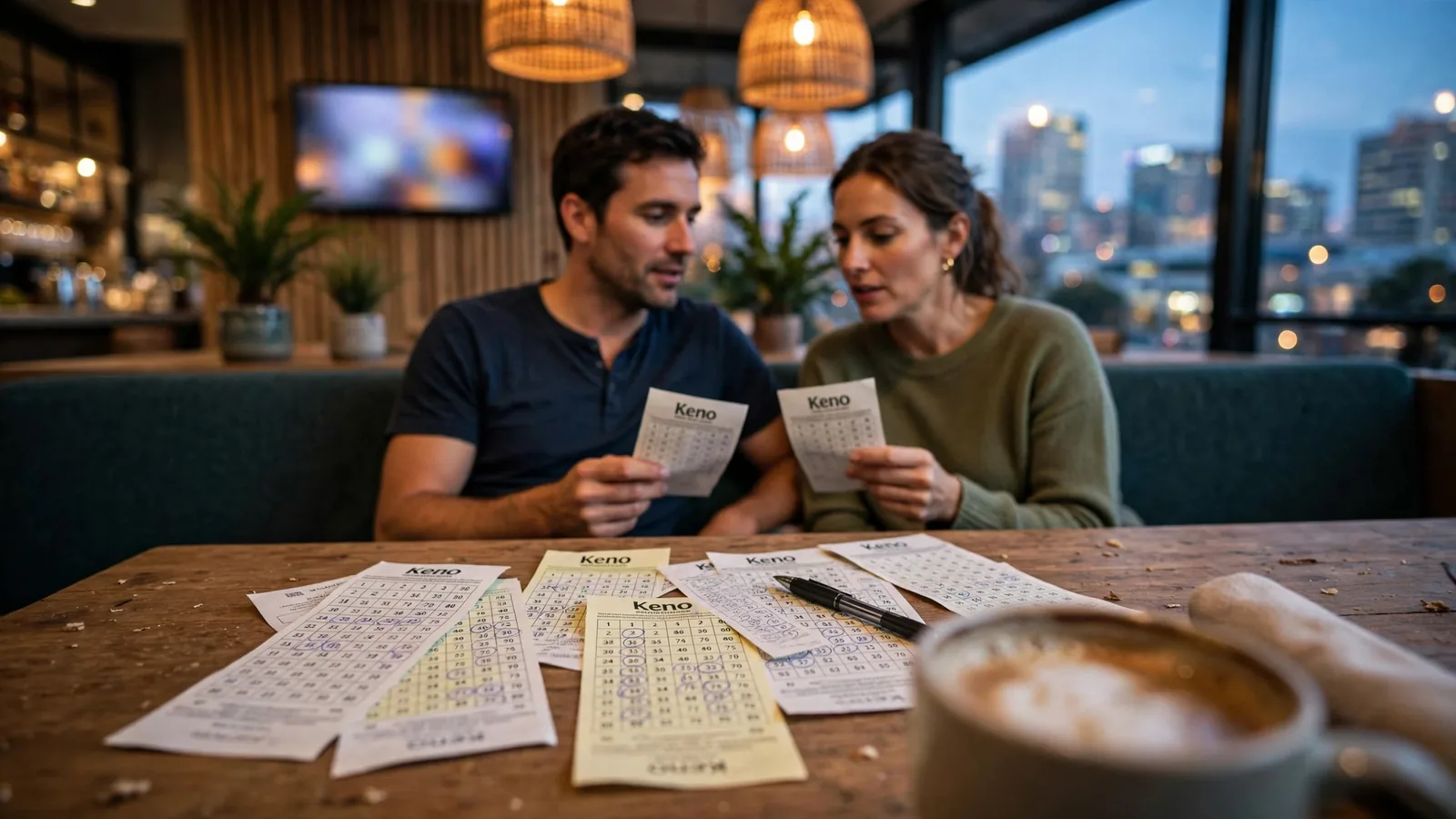
Online Keno in New Zealand: How It Works
 Available in US
This guide explains number selection, draw schedules, game formats, prize structures, and the differences between free and real-money play.

Table of Contents
- How Online Keno Works in New Zealand
- Selecting Numbers and Playing a Keno Line
- Casino Bonuses, Terms, and the New Zealand Market
- Free Keno, Multiple Cards, and Demo Play
- Keno Game Formats and Prize Structures
- Keno Odds, Payouts, and RTP
- Random Draws and Responsible Keno Play
- Playing Keno for Real Money: Wagers and Withdrawals
- Draw Times, Entry Cut-Offs, and Four-Card Play
- Betting Amounts and Minimum Line Stakes
How Online Keno Works in New Zealand
Online keno is organised around a draw: a set of winning numbers is produced from a defined pool, and a player’s entry is assessed against that result. In New Zealand, the pool runs from 1 to 80, and each draw selects 20 winning numbers. This is the basic structure behind online keno in New Zealand in 2026, whether the game is presented through a casino-style interface or another online platform.
The draw result is separate from the way an individual entry is configured. The pool and the number of winning numbers describe the shared event; a line or card is the individual play associated with it. Keeping these parts distinct helps explain what a keno result represents without confusing the draw itself with the choices made when entering a game. Those choices can vary between games and belong to the practical process of setting up a line.
New Zealand keno has a set daily schedule. Draws take place at 10 am, 1 pm, 3 pm and 6 pm. The schedule gives the game recurring entry points rather than making it a continuous draw in which a result is generated at any moment. A player following the game can therefore identify the scheduled draw times, while the result remains tied to the particular draw entered.
Choosing an online keno site in New Zealand involves checking the details available for each operator before deciding where to play. This list highlights the specific licensing or payout information provided for each option.
Payout speed: 1-3 business days Wintino lists a payout speed of 1–3 business days, giving readers a specific timeframe to consider.
License: Curaçao Gaming Authority, licence no. OGL/2024/165/0185 BitStarz lists a Curaçao Gaming Authority licence, number OGL/2024/165/0185.
License: Tobique Gaming Commission, licence no. 0000002 Ricky Casino lists a Tobique Gaming Commission licence, number 0000002.
License: Tobique Gaming Commission, licence no. 0000064 Neospin lists a Tobique Gaming Commission licence, number 0000064.
License: Tobique Gaming Commission, licence no. 0000091 7Bit Casino lists a Tobique Gaming Commission licence, number 0000091.
License: Malta Gaming Authority, licence no. MGA/B2C/394/2017 N1 Casino lists a Malta Gaming Authority licence, number MGA/B2C/394/2017.
License: 07017519840 · Payout speed: 1-3 business days Zotabet lists licence number 07017519840 and a payout speed of 1–3 business days.
License: Malta Gaming Authority, licence no. MGA/B2C/370/2017 Play Grand lists a Malta Gaming Authority licence, number MGA/B2C/370/2017.
Payout speed: 1-3 business days Lamabet lists a payout speed of 1–3 business days, a detail readers can consider when reviewing the operator.
The format is straightforward to describe, but online presentations can make it appear more complicated. A screen may show a number grid, a card or line, a countdown, and a result area. These are interface elements around the same central process: the game defines a pool, a draw selects winning numbers from it, and entries are compared with the outcome. The display does not change the size of the pool or the number of winning numbers selected in the New Zealand draw.
The four daily times also provide a useful distinction between a game’s schedule and its visual pace. A casino keno interface may show movement, animations or a changing display, but these features should not be mistaken for additional draws. The defined schedule remains the relevant reference for when results occur. The visible presentation is a way of showing the game, not evidence that a separate result has been produced.
This framework applies across the common ways of describing the product, including casino keno played online and keno offered within an online casino. Those labels refer to the setting in which the game is accessed; the local draw format is still based on 20 winning numbers selected from 1 to 80. The format can be understood without assuming that every casino presents its game in the same way. Interface design, labels and supporting information may differ, while the stated draw structure provides the point of comparison.


For a clear account of a particular game, its displayed rules should be read alongside this general structure. The New Zealand schedule and draw format establish what is common to the local game, but they do not by themselves describe every feature of a casino’s interface or a specific game variant. The essential mechanics remain limited and identifiable: an 80-number pool, 20 winning numbers per draw, and four scheduled draws each day.
Selecting Numbers and Playing a Keno Line
A keno line begins with a choice of spots: the numbers selected from the game’s pool for that entry. In New Zealand online keno, the pool runs from 1 to 80, and a player may choose as many as 20 numbers. The available choice is not identical in every game, however. Some games accept between one and 10 spots per line, while others extend the selection to 15 or 20.
The first step is therefore to check the game’s rules before making a selection. The number of spots permitted affects the shape of the line, and a game that supports a broader range of choices offers a different selection task from one with a narrower range. The stated maximum for online keno does not mean every game offers every possible line size.
Building a line
Once the game’s permitted range is clear, spots can be selected from the number pool. The chosen spots form the line; they are not separate entries merely because several numbers appear on it. A line may contain a single spot or several, subject to the game’s rules. The selection should remain within the range that the particular game allows.
Building a Keno Line
- Check the game’s permitted range of spots
- Select numbers from the 1 to 80 pool
- Confirm the line size is within the game’s rules
- Verify that the displayed spots match the intended selection
Number choice can be made manually, where the game provides that option, or through an automatic selection feature if one is offered. These are alternative ways of creating a line, not different forms of keno. A manually selected line reflects the player’s chosen spots; an automatic selection delegates the choice to the game interface. Neither method changes the number pool or guarantees a particular result.
Before confirming an entry, the line should be checked for accuracy. This means confirming that the displayed spots match the intended selection and that the chosen line size is permitted. A crowded or small screen can make a selection harder to inspect, so the grid and game rules should be readable before the entry is submitted. If a game presents its options differently, its own instructions determine how a line is completed.
What the spot count means
The spot count is simply the number of selected numbers on a line. It can vary across keno games, so there is no single line size that applies universally. Some games allow a player to select only within a range of one to 10 spots, while others permit more, reaching 15 or 20. The overall New Zealand online keno pool contains 80 numbers, but a line need not include the whole pool.
This distinction helps clarify the rules for playing online keno: the pool defines which numbers are available, while the game’s spot options define how many may be selected on a line. These limits should not be confused. A pool of 80 does not imply that a line can contain 80 selections; the stated maximum for a player’s selection is 20, and individual games may set a lower limit.

A completed line is the selected set of spots for that entry. The essential choices are the game, the spots, and a line size allowed by that game. The rules and selection controls should be reviewed together, since the permitted options may differ from one keno game to another. This is the practical basis for playing a line; questions about how matches are paid, how much to stake, or when an entry closes depend on other parts of the game.
Casino Bonuses, Terms, and the New Zealand Market
A casino cash bonus may be usable on keno, but that possibility should not be treated as a general feature of casino offers. A specialist review has reported that such bonuses can apply; the terms of the particular offer determine whether keno is included. An offer may cover some casino games while excluding others, so the presence of keno in a casino’s game menu does not establish that it qualifies for bonus play.
The relevant conditions are the wagering requirement, the list of eligible games, and whether keno contributes to clearing the bonus. These terms affect whether keno play counts towards any stated clearance condition. If the rules do not clearly explain the treatment of keno, the offer’s apparent value cannot be assessed from the headline alone. The same applies when the terms distinguish between game categories: the category assigned to a keno title may matter as much as its availability in the lobby.
Bonus Eligibility
Attention: The presence of keno in a casino’s menu does not guarantee it qualifies for bonus play; always check the eligible games list and wagering requirements.
Bonus terms should also be read alongside the offer’s banking and withdrawal conditions on the operator’s current site. Conditions can differ between offers, and a promotional summary is not a substitute for the full rules. In particular, the bonus balance and cash balance may be governed by different conditions; the offer’s wording determines how play and any resulting balance are handled. No general conclusion about bonus eligibility can be drawn from the fact that a casino provides keno.
The licensing transition
The legal setting for online casino gambling in New Zealand changed in 2026. The Online Casino Gambling Act 2026 took effect on 1 May that year and created the country’s first domestic licensing framework for online casino gaming. This is a transition rather than a fully operational licensing market: the complete regime is not expected to be in place until 2027.
The Act provides a temporary continuation period from 1 May 2026 to 1 December 2026. Online casinos that were already serving people in New Zealand before the Act took effect may continue during that period, subject to its transitional provisions. A specialist market review describes the licensing process as underway, but that does not mean every online casino currently has a New Zealand licence. Nor does the transitional arrangement establish that a particular operator has been approved under the future regime.
This distinction matters when assessing claims about the best online casino for keno. A game selection, bonus offer, or promotional label is not evidence of New Zealand licensing. The regulatory status of a service depends on the applicable legal arrangements and the operator’s position within the transition, rather than on whether it markets keno to local players.

The background is also important. Under the Gambling Act 2003, online casinos could not be based in New Zealand. Before the 2026 Act, offshore online casino services were not licensed or supervised by a New Zealand regulator, and a customer using an offshore site had no domestic government recourse. The new law establishes a domestic licensing route, but its existence should not be confused with the completion of that route. During the transition, providers already operating locally may continue under the specified provisions; the full licensed system remains a later stage.
Offshore keno services are regulated by the operator’s home jurisdiction. That is separate from New Zealand oversight, and a foreign regulatory framework does not itself amount to a New Zealand licence. Online casino sites based offshore remain accessible to New Zealand residents, and players do not incur legal liability merely for using them. However, access should not be mistaken for domestic supervision or a local avenue of government recourse.
For anyone comparing online casino keno games, the practical review is therefore twofold. First, the bonus terms must say whether keno is eligible and how its play affects clearance. Second, the operator’s regulatory position must be understood in the context of the transition, rather than inferred from a casino’s marketing or its availability in New Zealand. A casino may offer keno and advertise a cash bonus without either fact resolving the other question. The offer rules establish bonus treatment; the legal framework establishes the relevant licensing context.
Free Keno, Multiple Cards, and Demo Play
Free online keno serves a different purpose from a real-money game. A demo lets players follow a game using virtual funds, without risking a cash balance. Any result remains within the practice environment: demo play cannot produce money that can be withdrawn or used as a real-money prize. This distinction matters even when the screen, controls and draw presentation resemble those of a paid game.
Demo Play
Demo versions use virtual funds and cannot produce withdrawable money or real-money prizes, regardless of the results achieved.
What demo play can show
A free version can make the sequence of play easier to understand. It may show how a card is displayed, how selections are entered and how results appear after a draw. These features can help establish whether the interface is readable on a particular device. They do not turn practice results into evidence of future performance, and they do not change the game’s real-money conditions.
Demo availability and presentation can differ between games. A free mode may be labelled “demo”, “practice” or “play for fun”; the wording alone does not alter its essential limit. The balance shown in such a mode is not a deposit, and a successful result does not create a cash entitlement. A player moving from a demo to a paid version is therefore moving into a separate activity with real financial consequences, rather than simply converting a practice balance.
This distinction also applies to free keno offered as a promotional feature. A free-play screen should not be confused with a cash bonus: a cash bonus has terms that determine whether it can be used for keno and how play contributes to its clearance. A demo, by contrast, uses fake money and does not generate withdrawable winnings. The label and the terms attached to a particular mode should be read before treating it as either practice or a financial offer.
Playing several cards at once
Multi-card keno allows several cards to be active in the same session. Selections can be spread across those cards, so the screen may show more than one set of play rather than a single card alone. This changes the amount of information to track during a draw: each card has its own selections and result, even when the cards are being played together.
The format may be available in free play as well as in real-money games, depending on the game. A free multi-card session remains a simulation; adding cards does not make its balance withdrawable or its results financially valuable. In a paid session, multiple cards are still separate entries and should be treated as part of the overall amount being put at risk. A crowded display can also make it harder to check each card, so the grid, stake amount and paytable should remain readable before play continues.
Descriptions such as four-card play refer to a multi-card arrangement, not to a different kind of real-money prize. Whether the cards can be viewed and managed clearly depends on the game interface and the device in use. On a smaller screen, checking the layout and the account limits is particularly relevant before using several cards together.
Free online four-card keno can therefore be useful for becoming familiar with a multi-card interface, while free single-card play provides a simpler view of the same general format. Neither mode establishes what a paid game will return. Practice is limited to understanding presentation and controls; real-money play involves an actual stake, and demo results cannot be carried across as winnings.
- Use demo mode to learn the interface
- Check account limits before playing
- Verify readability of the grid on your device
- Treat practice results as future performance
- Assume demo balances are deposits
- Confuse free-play screens with cash bonuses
Keno Game Formats and Prize Structures
Keno games can share a draw-based format while presenting prizes in different ways. The key distinction is whether the game uses a fixed paytable or links part of its prize structure to a progressive jackpot. These labels describe how a prize is determined; they do not, by themselves, establish how likely a particular result is or what a game will return over time.
In New Zealand, online keno does not have a rolling jackpot. Its prizes are fixed according to the number of spots played and the stake. The game’s paytable sets out the prize associated with each eligible result, so the amount is determined by the stated rules rather than by a jackpot pool that grows as play continues. A fixed prize can therefore be understood from the paytable before a round is played, although the applicable amount depends on the line and stake.
A fixed structure also means that prizes are not described as accumulating from one round to the next. The amount assigned to a result is governed by the game’s stated schedule. This is distinct from the idea of a shared or growing jackpot: a prize may be large relative to other listed prizes without being progressive. The defining feature is not its size but whether its value changes as players contribute to a pool.
Progressive jackpot keno is described differently in some specialist reviews of casino games: the jackpot accumulates as players play. That description concerns the progressive format and should not be treated as evidence that New Zealand online keno offers such a prize. The local format described here has fixed prizes, not a rolling jackpot. Availability and rules can differ between products and markets, so the label attached to a game is not a substitute for its published paytable and jackpot conditions.

Where a progressive prize is offered, the central structural difference is that the jackpot amount can change over time as contributions build it. The relevant prize is therefore not simply a fixed entry in a paytable. Its value may depend on the pool at the point it is won and on the product’s own rules. Those rules determine how contributions are handled and what event qualifies for the jackpot; no single trigger or contribution method can be assumed across all progressive games.
This distinction matters when comparing games that appear similar on screen. Two products may both use numbered spots and show prizes for matching results, yet one may list fixed amounts while another includes a jackpot whose value accumulates. A displayed prize table should make clear which outcomes have fixed awards and whether a progressive feature is present. If the jackpot is shown separately from ordinary prizes, it should not be read as though it were simply another guaranteed amount attached to every matching result.
The terminology can also be confusing when casino menus group keno with other game types. A title that uses the word “slot” does not establish that its prize structure is progressive, just as a keno label does not establish that a game has a jackpot. The rules and prize information for the specific product are the evidence for its format. Names and promotional descriptions alone do not explain whether a prize is fixed or accumulates.

Free-play versions do not alter this distinction in prize design. A demonstration can reproduce the presentation of a game, but its displayed results should not be confused with a real-money prize or a cashable jackpot. Likewise, playing several cards changes the number of lines in play, not the underlying definition of a fixed or progressive prize structure.
For New Zealand online keno, the relevant baseline is a fixed-prize format tied to spots played and stake. Progressive jackpot keno is a separate format whose jackpot accumulates as players take part, as described in specialist reviews; it should not be assumed to form part of the local keno offering. The paytable and rules for an individual game establish which structure applies.
Keno Odds, Payouts, and RTP
A keno payout depends on three connected elements: the stake, the number of selected spots matched by the draw, and the game’s paytable. The paytable assigns a prize to each relevant combination of spots played and matches made. A larger stake can increase the cash value of a listed prize, but it does not change how many numbers are drawn or make a match more likely.
The paytable therefore matters more than a headline prize figure when comparing potential returns. Two games may award different amounts for the same number of matches, or treat a particular match count differently. The stated prize is not a measure of the chance of receiving it; those are separate parts of the game’s terms.
RTP, or Return to Player, expresses the share of stakes a game is designed to return over extended play. It is a theoretical measure across many rounds, not a forecast of what an individual session will return. A player’s result can be above or below the stated RTP, and a favourable result in one round does not establish that the same result will recur.

The published ranges for New Zealand keno do not align. One set of estimates places RTP for most online games at 90%–96%, while another gives 92%–95% for classic 80-ball keno. These figures describe different scopes and should not be treated as interchangeable specifications for every game. The game’s own paytable is the relevant reference for its stated prizes.
House-edge estimates also conflict: one range is 25%–40%, while another is 4%–35%. The house edge represents the theoretical share of stakes retained by the game over time, rather than a fee deducted from each wager. Because the reported ranges overlap but differ substantially, they do not support a single precise figure for all online keno games in New Zealand. Game rules and paytables can vary, so a general market estimate cannot replace the terms shown for a particular game.
RTP and house edge are related measures of expected return, but the conflicting ranges mean they should not be combined into a single definitive claim about every title. For online keno played for money, the useful distinction is between the listed prize for a match and the long-run statistical measure: neither alone predicts the result of a short run of play.
Random Draws and Responsible Keno Play
Online keno in New Zealand relies on a Random Number Generator (RNG) to produce the winning selection. The draw is not determined by a player’s chosen spots, earlier results or apparent trends in the game. Each draw is random and independent, so a number appearing often in past results does not become more or less likely to appear in a later one.
Random Outcomes
Past results do not influence future draws. Treating patterns or “due” numbers as a winning strategy is a misconception that can lead to financial loss.
This distinction matters when interpreting result histories. A run of repeated numbers can look meaningful, but frequency records describe completed draws; they do not provide a reliable forecast. Nor does a number that has been absent for some time become “due”. Treating either pattern as evidence of an advantage gives past outcomes a predictive role that they do not have.
For the same reason, no selection method can be presented as a proven way to win. Choosing numbers based on birthdays, sequences or previous results may change the pattern on a card, but it does not change the random process that selects winners. Playing keno online therefore involves uncertainty that cannot be removed by tracking results or adjusting a selection strategy.
Responsible play follows from that uncertainty. Stakes should remain within established limits, and a losing run is not evidence that the next draw is more likely to produce a win. Increasing stake size after a losing run can expose a player to greater losses without changing the odds of the draw. Fast games also call for restraint: placing too many bets in quick succession can make spending harder to monitor. Account limits can help keep play within a defined boundary.
The interface should make the grid, stake amount, paytable and account limits readable before play begins. A secure connection is also appropriate when accessing an account, but an app does not make keno safer or improve the odds. Where an operator provides an app, its official link and requested permissions warrant review; support for the device and account location should also be checked.

These precautions do not make outcomes predictable. They separate decisions a player can control—such as stake size, pace and limits—from the draw itself, which remains random. Keno is best approached without treating previous results as signals or expecting a particular pattern to continue.
Playing Keno for Real Money: Wagers and Withdrawals
Playing online keno for real money involves more than placing a stake: the route used to withdraw winnings can affect when funds become available. Processing estimates should therefore be treated as method-specific, not as a single standard for every casino or account.
For Skrill and Neteller, a specialist affiliate review gives a withdrawal estimate of 1–12 hours at tier-one offshore operators, with that period beginning only after identity verification has been completed. This is a reported estimate, not a general guarantee. Verification may need to be completed before a withdrawal is processed, and the review’s timeframe should not be taken as evidence that every operator or transaction will meet it.
Direct bank transfers in New Zealand dollars commonly take 1–3 business days. That period is different from an e-wallet estimate and may reflect the time needed for the bank transfer to clear. A deposit appearing quickly does not establish that a later withdrawal will arrive at the same speed: operator processing and payment-network handling are separate parts of the transaction.
The practical implication is that withdrawal terms and verification requirements matter when assessing real-money play. The payment option shown in a cashier is not, by itself, a promise about the time taken to receive a withdrawal. Operators may have their own processing steps, while the payment method has its own transfer period. The current banking and withdrawal terms on the operator’s site are the relevant place to check the stated process.
Skrill and Neteller withdrawals are estimated at 1–12 hours at tier-one offshore operators after identity verification.
Direct transfers in New Zealand dollars commonly take 1–3 business days to clear.
Casual recreational gambling winnings in New Zealand are non-taxable.
Tax treatment is separate from payment processing. In New Zealand, casual recreational gambling winnings, including winnings from online keno, are non-taxable. This describes casual recreational play; it should not be extended to other income or circumstances without considering the rules that apply to them.
The financial distinction between a wager and a withdrawal is also important. A stake is money committed to a game, while a withdrawal is a request to transfer an available balance out of the casino account. The timing estimates above concern withdrawals, not how quickly a game settles or how soon a balance becomes eligible for cashout. A decision to play keno with real money therefore involves both the amount staked and the operator’s stated process for releasing funds.
Draw Times, Entry Cut-Offs, and Four-Card Play
Keno entry is tied to the draw rather than being an open-ended play session. In New Zealand, draws are scheduled for 10am, 1pm, 3pm and 6pm. A game can be entered up to the time its draw takes place. Once that draw has begun, a late entry cannot join it; play can instead start with the next draw.
This timing matters when a game is opened close to a scheduled draw. The relevant point is whether entry has been accepted before the draw, not simply whether the game page is visible. After a draw starts, the next available round provides the next entry opportunity. A displayed countdown or status indicator can help clarify which draw an entry is being placed into, but the operator’s game interface determines what is available at that moment.
The phrase “instant play” does not by itself establish that a game can be entered without an account or that an entry will be accepted at any time. Those are separate matters from the draw schedule. Account access and entry conditions depend on the service being used; no general no-sign-up arrangement can be assumed for online keno in New Zealand.

Four-card play refers to entering several cards in the same session, rather than changing the draw schedule. Keno can allow multiple cards to be played simultaneously, but the number available and how they are submitted are features of the particular game interface. A four-card option should therefore be confirmed in the game itself rather than inferred from the word “keno” or from a casino’s general description.
Where several cards are entered near a draw, the same cut-off applies to the entries: acceptance must occur before that draw begins. If the cut-off has passed, the next draw is the relevant opportunity. This distinction helps separate immediate access to a game from immediate entry into a particular round.
Betting Amounts and Minimum Line Stakes
The minimum stake for online keno is not described consistently across available accounts. One account places the minimum bet for a line at $1, while another gives NZ$0.10. These are conflicting figures, not two amounts that can be combined into a single market-wide threshold. The applicable minimum therefore needs to be read in the rules or stake display for the particular game.

A separate specialist review reports that a wager can start at NZ$0.10 per draw. That statement concerns a per-draw wager and does not establish a standard minimum across New Zealand keno games. It may also cease to reflect an operator’s current offering, so the displayed stake and current game rules are more relevant to a particular session than a general figure.
The distinction between a line minimum and a draw-level wager matters: the terms may describe different parts of the game, and one should not be substituted for the other. Before a stake is confirmed, the grid, stake amount, paytable and any account limits should be readable on the screen. Game rules should also be checked for the applicable stake limits. A clearly stated minimum does not indicate what a player will win; the amount payable depends on the wager, matches and the game’s paytable.
These figures should be treated as game-specific rather than as a reliable comparison between operators. Where the minimum is unclear, the game’s own displayed rules provide the relevant threshold for that line.
How does the page say players can start playing online Keno for real money?
Choose a permitted number of spots, set a stake, and enter before the draw; you can also join the next draw if you miss one. Wagers can start at NZ$0.10 per draw, though the minimum bet for a line is $1.
What does the page say about Keno odds, RTP, and house edge?
Most online Keno games have an RTP of 90%–96%, while the house edge typically ranges from 25% to 40%. Winnings depend on your stake, number of matches, and the game’s paytable.
Does a number being “hot” or “cold” affect its chances in the next Keno draw?
No. Draws are random and independent, so past number frequencies do not change a number’s chances in the next draw.
Can players play keno on a smartphone or tablet?
Yes, Keno can be played on an iPhone through a mobile browser or, where available, an operator’s app.
Is iPhone Keno different from desktop play?
The game’s odds are not improved by using an app; an app does not make Keno safer either. On an iPhone, you can access Keno through a mobile browser or, where available, an operator-provided app.
Prepared by the Casino Adviser NZ editorial staff.