Keno Results for New Zealand: Draw Times and Checks
 Available in US
Understand draw timing, published numbers, ticket matching and the limits of what live results can confirm.
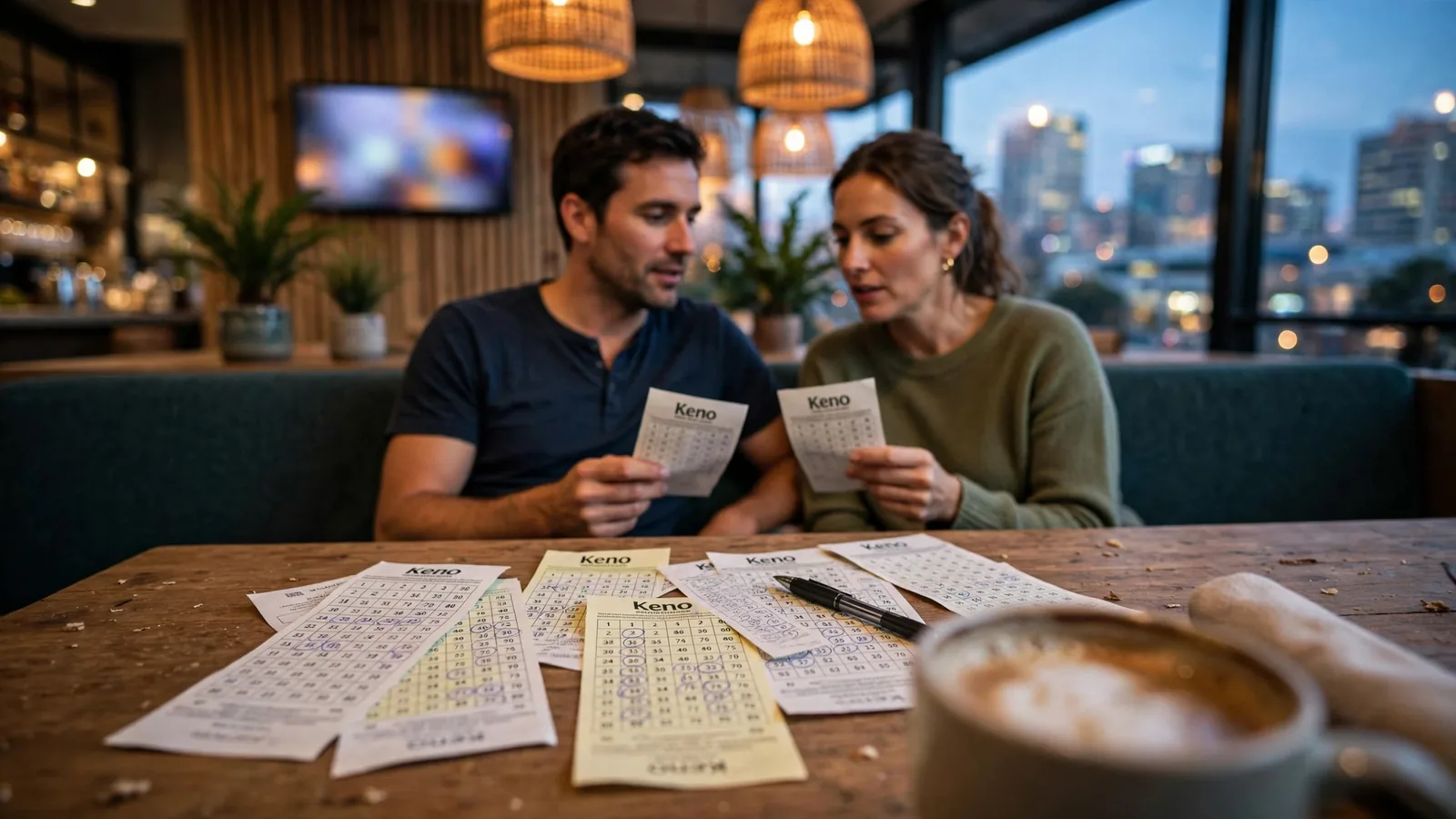
Table of Contents
- How New Zealand Keno Draws Work
- Live Results and the Next Drawing
- Daily Results and the Numbers Drawn
- What “Live” Keno Results Can Confirm
- Interpreting a Keno Result and Any Prize
- New Zealand Keno: Official Draws and Ticket Access
- Draw Timing, Multi-Draw Tickets and the Multiplier
- How to Check a Keno Result Against a Ticket
- Today’s Results and the 2026 Reference Point
- Number Generators, Quick Pick and Prediction Limits
How New Zealand Keno Draws Work
New Zealand Keno uses a fixed draw format: twenty numbers are selected from a pool of eighty. The draw is separate from the numbers chosen for a ticket. This distinction provides the basic framework for reading Keno results: the published draw records the selected numbers, while a player’s line records their own selection.
Draws take place four times each day, at 10:00 am, 1:00 pm, 3:00 pm and 6:00 pm in the Pacific/Auckland time zone. The scheduled times are not evenly spaced: the interval from the morning draw to the early-afternoon draw differs from the interval between later drawings. For anyone reviewing Keno NZ results, the time attached to a result therefore matters as much as the date. Two results published on the same date can refer to different drawings.
The schedule is a useful reference point for understanding a result, but it does not mean every display of results changes at the instant a scheduled drawing begins or ends. A time identifies the drawing to which the result belongs; it should not be treated as a guarantee about when a particular page or display will update. That distinction matters when looking for the latest New Zealand Keno results, since “latest” depends on which scheduled drawing has taken place and which one a displayed result identifies.
For New Zealanders checking keno results in 2026, this list offers a concise reference to operators and the specific details available about each. Review those details alongside the information relevant to your own needs.
Payout speed: 1-3 business days Wintino lists a payout speed of 1–3 business days.
License: Curaçao Gaming Authority, licence no. OGL/2024/165/0185 BitStarz lists a Curaçao Gaming Authority licence, number OGL/2024/165/0185.
License: Tobique Gaming Commission, licence no. 0000002 Ricky Casino lists a Tobique Gaming Commission licence, number 0000002.
License: Tobique Gaming Commission, licence no. 0000064 Neospin lists a Tobique Gaming Commission licence, number 0000064.
License: Tobique Gaming Commission, licence no. 0000091 7Bit Casino lists a Tobique Gaming Commission licence, number 0000091.
License: Malta Gaming Authority, licence no. MGA/B2C/394/2017 N1 Casino lists a Malta Gaming Authority licence, number MGA/B2C/394/2017.
License: 07017519840 · Payout speed: 1-3 business days Zotabet lists the licence identifier 07017519840 and a payout speed of 1–3 business days.
License: Malta Gaming Authority, licence no. MGA/B2C/370/2017 Play Grand lists a Malta Gaming Authority licence, number MGA/B2C/370/2017.
Payout speed: 1-3 business days Lamabet lists a payout speed of 1–3 business days.
The same structure applies whether someone is checking a result from earlier in the day or looking back at a previous date. The draw remains a selection of twenty numbers from the same pool of eighty. A result described as yesterday’s Keno draw is not a different kind of draw; it is a result associated with the relevant date and scheduled time. The format itself does not change according to whether the drawing is current or historical.
There are four scheduled opportunities each day, rather than a continuous draw. The listed times are the reference points for separating one drawing from another. For example, a result associated with 3:00 pm is distinct from the result associated with 6:00 pm, even though both belong to the same calendar day. When a page presents results for “today”, the date alone may not identify which of those drawings is meant; the draw time completes that context.
The number pool also stays conceptually separate from the draw outcome. Eighty is the full set from which the drawn numbers are selected, and twenty is the number selected for a drawing. These figures describe the draw’s structure, not an individual ticket’s result. A player’s own selection is not the draw, and the published set should be read as the outcome against which a ticket may later be considered. The mechanics of matching a ticket to that outcome are a separate question.

A result can therefore be understood through two simple details: its scheduled drawing time and the set of twenty numbers selected from eighty. Those details give a consistent frame for reading Keno results in New Zealand, whether the result is viewed on the day of the draw or later. They do not, by themselves, establish when a ticket was entered or what a particular ticket may receive; those questions depend on other details beyond the draw format.
Live Results and the Next Drawing
A live Keno result and a ticket’s entry into a drawing describe two separate stages. The ticket is assigned to a drawing according to when it was purchased relative to that drawing’s sales cutoff. A result becomes relevant only after the drawing has taken place and its outcome is available to view. Seeing a result described as live does not, by itself, establish which drawing a particular ticket entered.
In New Zealand, Keno drawings take place four times a day. A single play enters the next drawing whose sales cutoff has not passed. If the cutoff for the next drawing has already passed when the purchase is completed, the play goes into the following drawing instead. The key reference point for a ticket is therefore its assigned draw, not simply the calendar date on which its result is viewed.
In New Zealand, Keno drawings occur four times daily. A play enters the next drawing whose sales cutoff has not yet passed.
This distinction matters when checking a result on the same day as a purchase. A ticket bought earlier in the day may be entered in a drawing whose result is already available, while a ticket bought later may be assigned to a subsequent drawing. The phrase “today’s result” can refer to any result associated with the current date; it does not tell whether a particular ticket was included. The ticket’s draw assignment and the result’s date need to be considered together.
The words “live results” can also be used loosely. They may indicate that a page is displaying a current-day result, but they do not necessarily mean that a drawing is still in progress, or that a newly purchased ticket will enter the result being displayed. A result can be viewed live in the ordinary sense of being available during the day, while a ticket purchased after the relevant cutoff belongs to a later drawing. Result display and sales timing should not be treated as the same process.
The same issue arises with searches for a live draw time. A time associated with a result identifies the drawing to which that result belongs; it does not define the sales cutoff for the next drawing. A ticket’s cutoff determines entry, whereas a result’s time identifies the draw being reported. Confusing the two can lead to checking a result from the wrong drawing even when the date appears correct.


A result from yesterday is similarly tied to the drawing it records, rather than to a ticket’s purchase date alone. If a ticket was entered in a drawing on the previous day, that is the result relevant to it, even if the ticket is being checked today. Conversely, a result from yesterday cannot apply to a ticket assigned to a drawing today. The date is a useful locator, but it is not a substitute for identifying the drawing printed or recorded for the play.
“Tonight’s results” is a time-relative description, not a separate draw category. It may refer to a result from a later drawing on the current date, but the phrase does not show whether a ticket entered that drawing. The purchase must have been completed before the applicable sales cutoff for that entry. If the cutoff has passed, the ticket is assigned to the following drawing, even if the earlier result is still the one most recently shown.
Searches that mention New Zealand and “live” may also be confused with results from another jurisdiction. In particular, a reference to NSW concerns a different location and should not be taken as the New Zealand result. The relevant result must correspond to New Zealand Keno and to the drawing assigned to the ticket.
Avoid confusion with other jurisdictions; for example, results referencing NSW are not New Zealand Keno results.
For same-day checking, the useful sequence is to establish the ticket’s assigned drawing first, then locate the result for that drawing. A date alone can be insufficient when several drawings occur during the day. The sales cutoff governs entry; the draw identifier or time distinguishes which result belongs to that entry. Neither the current date nor a live label changes those underlying distinctions.
Daily Results and the Numbers Drawn
A daily Keno result is the set of numbers produced by a particular drawing. In New Zealand, that set contains 20 numbers drawn from the game’s pool of 80. It is separate from the numbers entered on an individual ticket: the draw produces its own result, while a player chooses a line of between one and ten numbers.
This distinction matters when reading Keno results today. A list of drawn numbers is not a list of numbers selected by a player, nor does it show how many numbers any particular ticket matched. The result records the outcome of the draw; a ticket records the player’s selection. Only by considering both can an outcome for that ticket be identified.
What a daily result represents
The daily results refer to the numbers drawn, not to every player’s ticket or to a summary of all prizes. Each drawing has a set of 20 drawn numbers. That set is the same reference point for all tickets entered in that drawing, even though players may have chosen different numbers or different line sizes.


The phrase “Keno result today” can refer to a particular drawing’s outcome rather than to one combined result for the whole day. Where more than one drawing has taken place, the result belongs to a specific drawing. The numbers should therefore be understood as a single draw’s outcome, not as a running total in which numbers from separate drawings are combined.
A result displayed as a row or list is simply a presentation of those drawn numbers. Its order or layout does not change what the set represents. The important distinction is between the numbers included in the draw result and those written on a ticket.
Drawn numbers and player selections
Players choose between one and ten numbers in Keno. The draw, by contrast, produces 20 numbers from the pool of 80. A player does not choose which 20 numbers will be drawn. The selected line and the draw result are different sets, and the relevant relationship between them is whether the line contains numbers that also appear in the drawn set.
For instance, a ticket may contain a shorter or longer line within the permitted range, while the result still consists of the same type of 20-number draw. The size of the player’s line does not alter the draw itself. Nor should the 20 numbers shown in today’s Keno results be mistaken for a recommended selection for a later ticket.
This terminology helps prevent a common reading error: “numbers drawn” and “numbers played” are not interchangeable. The first describes the outcome; the second describes the player’s choice. A result page may show the former without showing the latter, because ticket selections differ from one player to another.
- Treat drawn numbers as the outcome of the draw
- Distinguish the drawn set from the player’s selected line
- Mistake drawn numbers for a player’s selection
- Use today’s results as a guide for later tickets
Reading today’s result as a record
Today’s Keno results are best treated as a record tied to an individual drawing. The numbers state what came out in that draw; they do not, on their own, describe a player’s entry or establish a ticket outcome. That remains true whether the list is viewed soon after a draw or later in the day.
The result is therefore a fixed set for the drawing it identifies, not a prediction or a selection guide. Its role is to record the drawn numbers so they can be distinguished from the line chosen for play. Keeping those two sets conceptually separate makes the daily result easier to interpret without implying that the player selected the draw itself.
What “Live” Keno Results Can Confirm
A “live” label describes how a result is being presented; by itself, it does not establish that the displayed numbers are an authoritative Keno result. The label may indicate that a page is showing information associated with a current or recent drawing, but it is not proof of who supplied the information, whether it has been checked against Lotto New Zealand’s result, or whether it is the result used to assess a ticket.


This distinction matters when looking for Keno results today. A page can reproduce numbers in real time or soon after a drawing without becoming an official record. A result copied to another website, app, or social post carries no guarantee and is not what a retailer will pay against. The appearance of a complete set of numbers, a timestamp, or a “latest results” heading does not, on its own, verify the result.
What a live display can show
A live-results page can provide a convenient view of numbers that it attributes to a particular drawing. It may help identify information to compare with the official result, but its evidential value depends on the source and the link between the displayed numbers and the relevant drawing. Without that connection, the display confirms only what that page is showing.
The distinction is especially important for a result described as live tonight. A current-looking screen is not necessarily an official confirmation, and the word “live” does not guarantee that the information is complete or correct. A result may also be repeated across several pages; repetition is not independent verification if those pages have copied from the same source.
Lotto New Zealand runs Keno in New Zealand, so an official result should be distinguished from a third-party reproduction. If a discrepancy arises, the reproduced version should not be treated as decisive simply because it appeared first or is easier to access. The relevant point is whether the result corresponds to the official record for the drawing, not how prominently a page labels it.
Attention A “live” label describes how a result is presented and does not guarantee that the information is an official record or verified by Lotto New Zealand.
Regulation is not result verification
The regulatory context does not make every live Keno display official. The Department of Internal Affairs is New Zealand’s primary gambling regulator, and it oversees the online casino licensing framework. The Gambling Commission handles casino licensing applications and licence decisions. Those functions concern gambling regulation and online casino licensing; they do not turn a third-party Keno feed into an official draw record.
New Zealand Keno is operated by Lotto New Zealand. A page discussing casino licences, or displaying a casino-related regulatory notice, should therefore not be taken as evidence that its Keno results have been verified by the regulator. The identity of a regulator and the source of a particular result are separate matters.
A live Keno result can be useful as a prompt to verify, but it should not be treated as a payment decision. Retail payment is not guaranteed by a number set reproduced elsewhere. If a display conflicts with the official result, reliance on the reproduced version is not justified. The same caution applies when a page uses terms such as “confirmed” without making clear which official record supports that claim.
For a sound assessment, the result needs to be tied to the correct drawing and checked against the operator’s official information. A live label may describe presentation or timing; it cannot, on its own, establish authenticity, settle a discrepancy, or guarantee what a retailer will pay.


Interpreting a Keno Result and Any Prize
A Keno result describes the numbers drawn; a ticket’s outcome depends on how many of the numbers on its line match that result. The match count is not, by itself, enough to establish a prize amount: the applicable prize terms also matter. Different line sizes and outcomes should not be assumed to share the same payout.
A ten-spot line provides a clear illustration of why a top match is distinct from a partial match. A specialist review reports odds of roughly one in 8.9 million for matching all ten numbers and a fixed payment of $250,000 per dollar wagered for that outcome. Those figures are the review’s account of a particular prize condition, not a general description of every Keno result or a guarantee of what a ticket will receive. A partial match is a different outcome, and its value cannot be inferred from the top-match figure.
Previous Keno results can show which numbers were drawn on earlier occasions, but they do not alter how a ticket’s matches are counted or determine a future prize. Each result must be considered against the relevant line and the prize terms that apply to it. A list of past numbers is therefore not a substitute for establishing the outcome of a particular ticket.
There is also a fixed claim period. A Keno prize must be claimed within twelve months of the draw date. If that period passes without a claim, the prize is forfeited and the money is transferred to the Prize Reserve Fund. The draw date, rather than the date on which a result is later viewed or copied elsewhere, is the reference point for that deadline.
Keno prizes must be claimed within twelve months of the draw date, or the prize is forfeited to the Prize Reserve Fund.
On tax treatment, a specialist review states that lottery prizes are not taxed in New Zealand, while interest earned on prize money is taxable. This distinction is between the prize itself and income subsequently generated from it; it should not be read as a statement about the tax rules of another country. Overseas residents may be subject to rules where they live.
A displayed result and a prize determination are related but not identical. The drawn numbers indicate the possible matches, while the ticket’s line and the applicable prize conditions establish what those matches mean financially. Where the result or payout is uncertain, the reported top-match example should not be used to calculate a different outcome.
New Zealand Keno: Official Draws and Ticket Access
New Zealand Keno is operated by Lotto New Zealand, so the local game is distinct from Keno-style products offered by overseas casinos or other providers. A result described as a New Zealand Keno result refers to this Lotto NZ game, not automatically to every game using the name “Keno”. The distinction matters when looking at results: products with similar names may have different operators and rules.
Tickets for the New Zealand game are available through Lotto NZ retailers and online through MyLotto. These are the stated local channels for entering the draw. Players must be physically present in New Zealand to buy tickets, including when using an online channel, and must be at least 18 to purchase or claim lottery products.

The operator and the ticket channel provide useful context for identifying the product, but they are not interchangeable. A retailer sells Lotto NZ tickets, while MyLotto is its online channel; neither fact makes an overseas casino game part of the New Zealand lottery. Likewise, a page showing Keno results from another country, such as Belgium, concerns a separate product unless it explicitly identifies the Lotto NZ game. The shared game name alone is not evidence that the results apply to a New Zealand ticket.
This distinction also limits what should be inferred from general online gambling information. New Zealand Keno is a lottery product run by Lotto New Zealand. Rules or licensing arrangements described for online casino gambling do not establish who operates Keno or where its tickets are sold. The relevant local context is the Lotto NZ product and its retailer and MyLotto sales channels.
For someone locating New Zealand Keno results today, identifying the operator is a practical first step: results labelled for the Lotto NZ game should not be confused with results for an overseas Keno-style game. A result page’s wording may not, by itself, establish that it belongs to the local product. The operator’s identity and the ticket channel help define which game is being discussed, while the draw-specific information remains essential for matching a result to an entry.
Physical locations where players can purchase official New Zealand Keno tickets.
The official online channel for entering New Zealand Keno draws.
Independent businesses that are not official Lotto NZ sales channels.
The local access arrangements are therefore straightforward in scope: Lotto NZ runs Keno, and tickets are sold through its retailers and MyLotto. This does not mean that every website displaying Keno results is an official Lotto NZ channel, nor that an overseas service selling or displaying another Keno product is connected with Lotto NZ. Third-party ticket services are independent businesses, not Lotto NZ sales channels.
Draw Timing, Multi-Draw Tickets and the Multiplier
A multi-draw ticket keeps one number line in play across consecutive Keno drawings. It is therefore different from buying a separate ticket for each drawing: the selected numbers remain the same while the ticket covers a run of draws. Each result still belongs to its own drawing, so a multi-draw entry does not turn several results into one combined outcome.
New Zealand Keno is drawn four times daily, at 10 am, 1 pm, 3 pm and 6 pm New Zealand time. A ticket must be purchased before the sales cutoff for the drawing it is intended to enter. A multi-draw ticket can carry the same selection into consecutive drawings, but the relevant cutoff still matters for entry. If a purchase misses the cutoff, it enters the following drawing rather than the one that has just closed.
This distinction matters when looking at Keno draw results today. A result displayed after a drawing relates to that particular draw, not automatically to every drawing covered by a multi-draw ticket. The ticket’s covered sequence and the time of each result must be considered separately. The same principle applies when viewing live results: the display concerns a draw, while the ticket determines which drawings were entered.

The Multiplier is an optional feature separate from the number line. It is assigned independently; it is not another number chosen by the player and does not alter the selection that is carried from draw to draw. It also cannot be added after the ticket has been bought, and it does not multiply the jackpot.
A multi-draw ticket thus combines repeated entry of the same numbers with separately determined results. The Multiplier is a distinct ticket feature, not a way to change the numbers or redraw the outcome. These distinctions help explain why a result for one drawing should not be treated as a summary of the whole ticket’s sequence.
How to Check a Keno Result Against a Ticket
Start with the ticket, not a list of numbers displayed elsewhere. Identify the drawing or drawings covered by the entry, then compare the result for that specific draw with the numbers printed on the ticket. A result from another time cannot establish whether the ticket won, even if it is from the same day.
The ticket’s purchase timing helps identify the relevant drawing. A single-play ticket is assigned to the next draw whose sales cutoff has not passed. If the purchase comes after that cutoff, the entry applies to the draw after it instead. Where the ticket does not make the applicable draw clear, the sales record or retailer can help resolve which result should be checked.
Checking a Result
Establish the specific drawing or drawings covered by your ticket entry.
Match the numbers printed on your ticket against the result for that specific identified draw.
Have the ticket checked through a Lotto NZ retailer or MyLotto to confirm any prize.
For a paper ticket, compare its printed numbers against the result for the identified draw, taking care not to confuse the player’s selection with the numbers drawn. For an online entry, use the account and ticket details to locate the play and its associated drawing. Lotto NZ sells Keno tickets through its retailers and MyLotto; the relevant ticket record is more useful for verification than an unattributed copy of a result.
A matching count can indicate whether a prize may be due, but a reproduced result is not a payment confirmation. The retailer does not pay solely on the basis of a third-party display. Keep the original ticket intact, or retain access to the online entry, and have the ticket checked through the applicable Lotto NZ channel before treating the result as settled.
The draw date also matters after a possible win. Keno prizes must be claimed within 12 months of that date. Once that period has passed, an unclaimed prize is forfeited and returned to the Prize Reserve Fund. Checking promptly therefore helps distinguish a result that appears favourable from a claim that has actually been validated, while leaving the official ticket-checking process to establish the outcome.
Today’s Results and the 2026 Reference Point
A result described as today’s New Zealand Keno result needs a draw time as well as a date. The game’s scheduled daily draws are at 10:00 am, 1:00 pm, 3:00 pm and 6:00 pm in the Pacific/Auckland time zone. A results page that shows only a date may therefore leave unclear which drawing its numbers belong to.
The year in “New Zealand Keno results for 2026” identifies the period of interest; it does not create a separate version of Keno or alter the daily schedule. For a particular result, the relevant reference is the date and scheduled time attached to that drawing. This matters when several results are published on the same day: the date alone does not distinguish them.

A result sought during the day may also refer to different drawings depending on when it is viewed. The listed times provide the schedule context, but a date-specific result should still be read alongside its stated draw time. Time-zone wording is useful where results are viewed outside New Zealand, because a local clock elsewhere may show a different time for the same event.
For historical records, the year helps separate results from different calendar periods, while the draw’s own date and time identify the individual event. The 2026 label is not evidence that a displayed result is current or belongs to a particular draw. Its date and scheduled time need to agree with the result being referenced.
Number Generators, Quick Pick and Prediction Limits
A number generator can select a Keno line at random, but it cannot forecast which numbers will be drawn. In New Zealand Keno, players choose between one and ten numbers from the available range, or use Quick Pick to have a selection made randomly. The method changes how the line is chosen, not the draw’s outcome or the chance of a particular line matching.
Past results do not provide a reliable signal for a future drawing. Keno draws are independent: a number appearing often, rarely, or not recently does not become more or less likely on that basis. Hot, cold and “due” number systems therefore describe patterns in historical results; they do not establish a predictive advantage.
The same limitation applies to websites, apps, charts and other tools that claim to identify winning combinations. A generated line may look systematic, and a forecast may be presented with statistical language, but neither changes the odds. Random selection is a way to choose numbers without choosing them manually
How does the New Zealand Keno number generator work?
Each draw selects 20 numbers from a pool of 80. Draws are independent, so previous results do not affect the next selection.
How does Keno work in New Zealand?
Choose between one and ten numbers, or use Quick Pick to have numbers selected randomly. Twenty numbers are drawn from 80, and your ticket is checked against the result for its assigned draw.
What’s the top Keno prize?
Matching all 10 numbers on a ten-spot line pays a fixed $250,000 per dollar wagered.
Do hot and cold numbers work?
No. Keno draws are independent, so hot, cold or overdue numbers do not predict the next result.
What additional options can be included on a Keno ticket?
You can choose a multi-draw ticket to play the same numbers in consecutive draws. An optional multiplier may also be assigned separately from your number line.
How often are Keno NZ draws held?
There are four draws each day, at 10:00 am, 1:00 pm, 3:00 pm and 6:00 pm Pacific/Auckland time.
Published by the Casino Adviser NZ team.