Live Dealer Casinos in NZ: How to Assess Sites
 Available in US
Live dealer games use real-time video of professional dealers with physical equipment, alongside online tools for play and interaction.
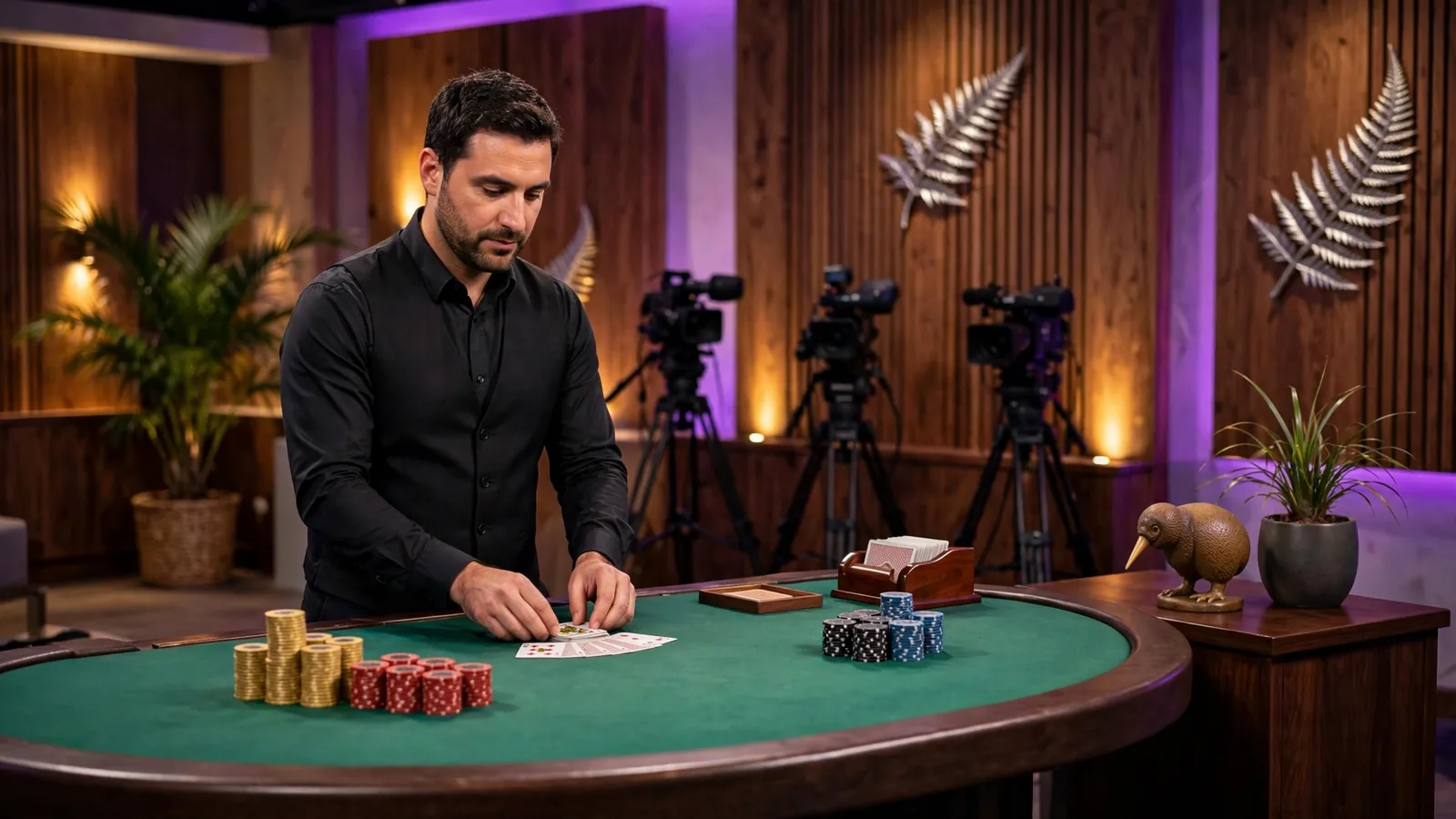
Table of Contents
- How Live Dealer Tables Work
- Live Dealer Casinos in New Zealand: The Licensing Transition
- What to Check When Assessing Live Casino Operators
- Live Play Online: Timing and Technical Limits
- Live Tables, Payments and Bonus Terms
- The Rules Behind Live Dealer Games
- What Makes a Live Dealer Game Genuinely Live
- Reading Casino Comparisons Without a Ranked List
- Finding Reliable Information About Live Dealer Sites
How Live Dealer Tables Work
A live dealer casino brings a table game to an online screen through a live video feed. Instead of relying only on a digital animation to represent each round, the format shows professional dealers working with physical game equipment in a studio. Depending on the game, that equipment may include real cards or a real wheel.
The dealer conducts the table while the video carries the action to players. This makes the experience different from a game in which every move is represented solely by computer-generated graphics: the cards are handled and the wheel is spun in the physical setting shown on screen. The online format connects that activity with an interface through which players can participate and interact with the dealer.
The term “live” refers to this real-time video presentation and the human-run table, not simply to a game’s visual style. A digital table may resemble a casino layout, but that appearance alone does not make it a live dealer game. In the live format, professional dealers and physical equipment are part of the broadcast.
Choosing a live dealer casino in New Zealand calls for checking what each listing can reliably tell you before deciding where to play. The notes below stick to the available details for each operator.
Payout speed: 1-3 business days Wintino lists a payout speed of 1–3 business days.
License: Curaçao Gaming Authority, licence no. OGL/2024/165/0185 BitStarz lists a Curaçao Gaming Authority licence, no. OGL/2024/165/0185.
License: Tobique Gaming Commission, licence no. 0000002 Ricky Casino lists a Tobique Gaming Commission licence, no. 0000002.
License: Tobique Gaming Commission, licence no. 0000064 Neospin lists a Tobique Gaming Commission licence, no. 0000064.
License: Tobique Gaming Commission, licence no. 0000091 7Bit Casino lists a Tobique Gaming Commission licence, no. 0000091.
License: Malta Gaming Authority, licence no. MGA/B2C/394/2017 N1 Casino lists a Malta Gaming Authority licence, no. MGA/B2C/394/2017.
License: 07017519840 · Payout speed: 1-3 business days Zotabet lists licence identifier 07017519840 and a payout speed of 1–3 business days.
License: Malta Gaming Authority, licence no. MGA/B2C/370/2017 Play Grand lists a Malta Gaming Authority licence, no. MGA/B2C/370/2017.
Payout speed: 1-3 business days Lamabet lists a payout speed of 1–3 business days.
The studio setting also shapes the experience. Players view the same ongoing table action through the feed, while the dealer manages the game on camera. The arrangement brings elements of a casino table into an online setting without requiring players to be physically present at the venue.
The format can cover different kinds of table games, but its defining features remain consistent: a live video feed, professional dealers and real equipment such as cards or wheels. Interaction takes place through the online service while the dealer carries out the game in the studio. This combination of physical table activity and digital access is what distinguishes live dealer play from a wholly automated online game.
Live Dealer Casinos in New Zealand: The Licensing Transition
The legal position for live dealer casinos in New Zealand is changing from a market without domestic online-casino licensing to one governed by a local licensing regime. The Online Casino Gambling Act 2026 took effect on 1 May 2026, establishing the framework for that change. Live dealer tables fall within the same licence category as online slots and digital table games; they are not treated as a separate kind of online casino service.
Before the Act, New Zealand had no domestic licensing framework for online casinos. The Gambling Act 2003 did not permit online casinos to be based in the country, and offshore online casino services were not licensed or supervised by a New Zealand regulator. That absence of local licensing did not, however, prohibit Kiwi players from accessing offshore platforms. New Zealand also has no separate Kiwi-specific gambling licence: the new regime concerns licences for the online casino sector as a whole.

The transition period
The new regime is being introduced in stages. Its transitional window runs from 1 May to 1 December 2026. Online casino providers that were already serving people in New Zealand before the Act took effect may continue operating during this period, subject to the Act’s transitional provisions. This temporary permission is distinct from holding a licence under the new system.
The transition does not make every offshore operator eligible to continue indefinitely. From 1 December 2026, only operators approved under the new regulations will be legally permitted to accept New Zealand players, subject to the transitional arrangements for applications still awaiting a decision. Providers that have not applied must stop serving the market by that date. Where an application remains pending, the provider may continue operating without advertising until the Department of Internal Affairs reaches a decision. If an application is declined, the provider must cease its online casino operations in New Zealand and leave the market.
These distinctions matter when interpreting a site’s availability during the transition. Continued access before the deadline does not itself demonstrate that an operator has secured approval, while a pending application is not the same as a granted licence. The transitional rules determine what a provider may do during this interval; they do not establish a permanent licence status.
A capped licensing system
The Act permits a maximum of 15 licences for the online casino sector, including services with live dealer tables. The cap applies across the relevant online casino category rather than creating a separate allocation for live dealer casinos. A licence in this framework therefore concerns the operator’s online casino services, which may include live tables alongside other covered games.
Licensing Cap
The Online Casino Gambling Act 2026 permits a maximum of 15 licences for the entire online casino sector, including services that provide live dealer tables.
From 1 December 2026, the permitted market is limited to approved operators within that capped system, with the pending-application transition applying where relevant. The cap should not be read as a guarantee that 15 licences will necessarily be issued: it sets the maximum number the framework allows. Nor does the existence of the framework mean that every operator previously accessible to Kiwi players will qualify to continue.
The full licensed regime is expected to become operational in 2027. Until then, the transition provisions remain important to the legal status of providers already active in New Zealand. The dates mark different stages: the Act established the framework in May 2026, the transition ends in December, and full operation is expected later. Treating these as a single change would obscure the difference between temporary permission to operate and approval under the new system.
For Kiwi players, the central change is therefore not that offshore access was previously prohibited and has now been opened. Offshore platforms were accessible despite the absence of domestic licensing. The change is the introduction of a New Zealand licensing structure and a defined point after which unapproved providers generally cannot accept local customers, while pending applications receive the specified temporary treatment. Live dealer tables are included in that structure under the same licence category as online slots and digital table games.
What to Check When Assessing Live Casino Operators
For Kiwi players, access to live dealer games at offshore sites does not by itself establish that an operator is properly regulated. The relevant checks concern the operator’s regulatory status and whether its claims can be confirmed independently. These checks provide a basis for assessing oversight; they do not establish that a site is suitable for every player or guarantee how a dispute will be resolved.

Identify who regulates the operator
An offshore site should be regulated by a recognised gambling body. The operator’s own statements about regulation are a starting point, not confirmation: a licence claim should be assessed against information from the regulator and the Department of Internal Affairs (DIA). If the operator does not identify a regulator clearly, or the claimed status cannot be confirmed, the available evidence is insufficient to treat the claim as established.
The distinction between an operator and the games it offers matters. A live dealer game may be supplied by a separate company, but the presence of a familiar game provider does not, on its own, verify the casino operator’s regulatory standing. The relevant question is whether the business accepting players is subject to oversight by a recognised gambling body.
Confirm the operator’s status with the DIA
The DIA is the appropriate point of confirmation for an operator’s licence status in the New Zealand context. A site’s wording should not be treated as equivalent to confirmation by the department. Where the operator refers to a licence, the name of the business and the nature of the claim should be clear enough to check with the DIA.
The check should focus on the specific operator, rather than on a broad claim that a group, brand or service is regulated. If the information available does not connect the named site to the relevant operating entity, the status remains unclear. A mismatch or an inability to confirm the claim is a reason to withhold judgement, not evidence that the site has been approved.
- Assess licence claims against information from the regulator and the DIA
- Confirm the current regulatory status of the specific operating entity
- Treat an operator’s own statements as independent confirmation of regulation
- Rely on logos, badges, or the presence of a known game provider as proof of oversight
Regulatory status is also time-sensitive. A statement published earlier may not describe the operator’s position at the time of assessment. Confirmation should therefore relate to the current status, rather than relying solely on old promotional material, archived pages or a third-party description that does not show when it was checked.
Read regulatory claims precisely
Terms such as “licensed,” “regulated” or “authorised” can sound conclusive while leaving important details unstated. A useful assessment distinguishes a specific, verifiable claim from general assurances. The regulator should be identifiable, and the operator should be identifiable as the entity covered by the claim. If either element is vague, the claim cannot carry much evidential weight.
A logo or badge displayed on a website is not, by itself, proof of current oversight. Nor does a statement that an operator follows industry standards establish that a gambling regulator has granted or maintains a licence. Such material may indicate what the business claims, but confirmation requires checking the status with the relevant body and the DIA.
This approach avoids treating regulation as a single label. An offshore operator may refer to oversight in another jurisdiction, while New Zealand has no Kiwi-specific gambling licence. The meaningful question is therefore whether the offshore site is regulated by a recognised gambling body and whether its stated position can be confirmed—not whether it displays a New Zealand licence.
Treat uncertainty as a finding
A careful assessment can end with an unresolved result. If the regulator is not named, the operating company is difficult to identify, or the DIA cannot confirm the stated licence status, the evidence does not support describing the operator as verified. That conclusion is narrower and more useful than assuming that a polished website or a confident claim demonstrates oversight.

The same restraint applies in the other direction: an inability to confirm a claim is not, by itself, proof of misconduct. It means the regulatory position has not been established from the information available. Separating that conclusion from stronger allegations keeps an assessment proportionate to its evidence.
These checks concern regulatory standing, not the quality of a live dealer broadcast, the range of tables or the speed of account transactions. Each is a separate matter and should not be used as a substitute for checking who regulates the operator. A clear, independently confirmable status is a basic part of assessing an offshore live dealer casino; where confirmation is absent, confidence in the regulatory claim should remain limited.
Live Play Online: Timing and Technical Limits
A live dealer game combines a video broadcast with an online betting interface. The dealer and table operate in a studio or a land-based casino, while players join remotely and take part through the game’s digital controls. Play therefore depends on two things working together: the live image must reach the screen, and the interface must register actions during the relevant part of the round.
The timing differs from play against automated software. In a live game, the dealer conducts the round and the interface opens a period for bets. That period is limited; once it closes, the next stage proceeds. A player joining a table is therefore entering a sequence already governed by the dealer and the table’s betting clock, rather than setting the pace of each round independently. The limit on betting time contributes to the faster rhythm of many live games.
Attention In live dealer games, betting periods are limited; if a player hesitates beyond the betting window, the interface will no longer accept the wager for that round.
This structure can make the timing feel more immediate, but it also leaves less room for hesitation. Decisions have to be made while the betting window is open. If a player is still considering an option when betting closes, the interface may no longer accept that wager for the round. The next opportunity depends on the table’s subsequent cycle. This is a feature of the shared pace of live play, not a difference in the rules of the game itself.
The video and the betting controls serve related but distinct purposes. The broadcast shows the table as the round unfolds; the interface communicates whether betting is open and accepts the player’s choices. A clear picture alone does not establish that a wager has been registered, just as an active interface does not guarantee that the video is displaying smoothly. These components need to remain sufficiently aligned for participation to be intelligible.
Because play is delivered by a live feed, the experience depends on a functioning connection between the broadcast and the online service. A specialist review reports that technical problems can occur in live dealer games. That possibility is relevant to the format, but it does not mean that interruptions are a routine feature of every session or that all operators handle them in the same way. The practical effect can depend on when the interruption occurs: a disruption during an open betting period presents a different difficulty from one that occurs while a round is already in progress.

An interruption can make it harder to follow the sequence of play or to tell whether the table has advanced. It may also leave uncertainty about the state of the interface at the moment contact with the game is lost. The live format does not itself resolve that uncertainty: the broadcast provides the visible activity, while the account and game interface determine what is recorded. The precise treatment of an interrupted round is not a universal property of live dealer play, and should not be inferred from the fact that the game uses a live stream.
Timing also matters when joining a table in progress. The betting window may already be open, nearing its close, or closed when the stream appears. The first visible moment is not necessarily the beginning of a round, so the pace can seem abrupt to someone arriving partway through the cycle. This is one reason the live format can feel less flexible than a game that can be started independently at any moment. Its rhythm is shared with the dealer and other participants.
The same arrangement explains why live games can move quickly despite involving a real person and a physical table. The dealer’s actions and the betting window structure the round, while the software relays participation from remote players. A short interval to place bets keeps the sequence moving, but it also means that the video and controls need to be followed together. There is no single pace that applies to every table, and the limits are set within each game’s operating format.

For Kiwi players, the most useful distinction is between ordinary timing and a technical interruption. A bet window closing is part of the game’s planned sequence; a stream or interface problem is an interruption to that sequence. Treating the two as the same can lead to confusion about whether a round has simply moved on or whether access to the live game has been disrupted. Live dealer casinos rely on real-time participation, but that does not remove the possibility of technical faults.
Live Tables, Payments and Bonus Terms
The payment arrangements attached to a live dealer account are separate from the table itself. Deposits and withdrawals are handled through the operator’s cashier, and the available methods, processing times and currency options depend on that operator. A payment option shown on one site should not be assumed to be available at another, even where both offer live tables.
Currency and payment methods
Many operators allow deposits and withdrawals in New Zealand dollars. Keeping an account in NZD can make the amount credited or returned easier to interpret, although the payment method and the operator’s terms still determine how a transaction is processed. Where an account or payment is handled in another currency, conversion may affect the amount received. Whether conversion applies, and how it is calculated, should be established from the relevant operator’s information rather than inferred from the games available.

Neteller, Skrill and Bitcoin are among the methods identified in specialist casino reviews as supporting fast deposits or withdrawals. Those reviews also note that methods can carry limitations or fees. This is not a guarantee of availability or speed at a particular site: the cashier’s current options and the payment provider’s conditions are more directly relevant to an individual transaction. A method may also work differently for deposits and withdrawals, so the two processes should not be treated as interchangeable.
Published timing estimates require similar caution. One specialist review reports that crypto payouts can clear in under an hour, that POLi and e-wallet transactions take 24 to 48 hours, and that bank transfers take 5 to 7 business days. These are reported estimates, not a dependable schedule for every operator or transaction. Processing can depend on the site, the method and the circumstances of the withdrawal; the figures should therefore be read as claims from that review, not as established market-wide service levels.
The distinction between a withdrawal being requested and funds being received is material. A stated processing period may describe only one part of the process, and payment providers can have their own handling arrangements. The operator’s payment terms are the appropriate place to check what it says about withdrawals, while the payment provider’s terms may explain restrictions on the method itself.
Reading payment terms
A useful comparison focuses on the details that affect the transaction, not simply on whether a method appears in a list. The relevant points include whether the method supports both deposits and withdrawals, whether the account can be maintained in NZD, and whether fees or other restrictions apply. An option described as fast in a general review may not have the same timing in every case, and a deposit route does not necessarily establish that withdrawals can be made through it.
Identified in reviews as supporting fast deposits or withdrawals, though they may carry fees or limitations.
Reported estimates suggest transactions typically take between 24 to 48 hours.
Generally reported to take the longest, with estimates ranging from 5 to 7 business days.
The conditions should be checked at the point of use because payment information can change. A cashier may show the methods currently offered, while the terms explain how the operator treats transactions. If the information is inconsistent, the discrepancy matters: a broad claim about convenience does not resolve which terms govern an actual payment. This is particularly important when comparing a method’s reported speed with the operator’s own stated processing approach.
A fast deposit is also not evidence of an equally fast withdrawal. For that reason, payment claims are best treated as method- and operator-specific rather than as a feature of live play itself. The presence of streamed tables does not, on its own, establish anything about a cashier’s performance.
Bonus limits and conditions
A live dealer casino bonus is a promotion associated with an account or deposit, not a payment method. Its value and conditions should be considered separately from the speed or currency of a transaction. Under the applicable New Zealand market constraints, bonus offers are capped at NZ$100 or 200% of the deposit. The cap does not mean that every operator offers a bonus, nor does it establish that a particular offer is available to every customer.
The stated ceiling also does not describe all terms attached to a promotion. Any offer has to be read alongside its own conditions, including who is eligible and how the operator defines the qualifying deposit or bonus. A headline figure alone cannot establish the value of an offer in practice. No assumption should be made that a bonus can be withdrawn as cash, or that it applies to every game or account, unless the operator’s terms say so.
Promotional rules are also constrained by the regulatory transition. Operators are prohibited from advertising to people in New Zealand during that period. Advertising by licensed operators is permitted under tight rules, while sponsorships are prohibited. These restrictions concern how services and offers may be promoted; they do not turn a promotion mentioned elsewhere into proof that it is currently available or valid for a particular customer. Any bonus information should therefore be considered in light of the applicable rules and the operator’s current terms, rather than as a general promise attached to live tables.
Where a promotion is presented alongside a deposit option, the two should not be conflated. The deposit method determines how funds enter an account; bonus conditions govern the promotional credit. A payment method’s reported speed does not establish how a bonus is credited, and the cap on offers does not determine when a withdrawal is processed. Treating these as distinct parts of the account terms makes it easier to interpret the actual commitments without relying on a headline or a broad claim about casino payments.
The Rules Behind Live Dealer Games
Live blackjack and baccarat both use opposing hands, but their objectives are not the same. In blackjack, each player’s hand is measured against the dealer’s. The aim is to finish with a total closer to 21 than the dealer, without exceeding 21. Going over that boundary means the hand does not meet the game’s objective, even if the dealer later goes over as well.
Baccarat instead compares the player hand with the banker hand. The winning hand is the one closest to 9. A bet is placed on which side will finish with the higher value; the available outcomes are a player win, a banker win or a draw. The names of the two sides describe the hands in the game, rather than requiring a player to take on either role.
Comparing Blackjack and Baccarat
Blackjack involves reaching a total closer to 21 than the dealer without exceeding it. Baccarat compares a player hand and a banker hand to see which is closer to 9, with bets placed on the outcome (player win, banker win, or draw).
This difference affects what a wager represents. A blackjack player is trying to beat the dealer’s result by reaching a suitable total, while a baccarat wager predicts which of two hands will be nearer to 9. In baccarat, therefore, the central decision is about the outcome between the banker and player hands. In blackjack, the objective is tied to the player’s own hand in relation to the dealer’s.
These basic rules help distinguish the games without relying on their appearance or presentation. A live dealer casino game may show cards and a dealer on screen, but the decision structure still depends on the specific game. In blackjack, the benchmark is 21 and the dealer provides the comparison. In baccarat, the benchmark is 9 and the comparison is between the banker and player hands.
The shared terms can be misleading if treated as interchangeable: “player” in baccarat names one side of the hand comparison, while a blackjack player is the participant whose hand is assessed against the dealer. Understanding that distinction clarifies what each wager concerns and what counts as a favourable result, without assuming that the two games follow the same objective.
What Makes a Live Dealer Game Genuinely Live
A live blackjack table depends on a connection between physical play and the software displaying the game. The dealer handles actual cards, while a scanner reads markings or chips embedded in them. That reading allows the game software to register the cards dealt and keep its digital representation aligned with the action at the table.
This link matters because the on-screen hand is not simply generated by a random-number system and presented as a dealer’s result. The cards are dealt physically, and their identifying features are read so the software can reflect them in the game. The broadcast gives players a view of the table; the scanner provides a way for the software to record the cards. Together, these elements connect the physical action with the digital interface.
Live dealer games are transmitted from a studio or a casino located in a particular country. The video feed enables real-time play against human dealers, rather than showing a pre-recorded sequence. In blackjack, the scanned card information supports the game display while the broadcast shows the dealer and table. The digital interface and the live video therefore serve related but distinct roles: one presents the game state, and the other shows the physical setting in which cards are handled.
The label “live” is most meaningful when it describes this real-time relationship between a physical table, the broadcast and the software. A video of a dealer alone would not explain how the software knows which cards have been dealt; card recognition supplies that connection in live blackjack. Conversely, software that displays card values does not by itself establish that a real table is being broadcast.
This distinction concerns the game’s underlying process, not a guarantee about the quality of a particular stream or operator. A genuine live format combines actual dealing with a live transmission and a system that communicates the relevant card information to the game software. It is that physical-to-digital link, rather than the visual presence of a dealer on screen alone, that characterises live blackjack.
Reading Casino Comparisons Without a Ranked List
A numbered table of the ten leading live dealer casinos would imply that each operator had been assessed against the same evidence and that the differences between them could be meaningfully ordered. Without comparable, current information about the operators, that implication is not justified. A list can look precise while concealing gaps in what was checked, when it was checked, and how the ranking was produced.

The label “best” also depends on what is being compared. One assessment might prioritise the range of live tables, another the terms attached to promotions, and another the handling of account transactions. Those are distinct measures. Combining them into a single position requires a stated method and evidence that can be applied consistently. A ranking without those foundations is better understood as an editorial selection than as an independently established result.
This matters particularly in a market where regulatory arrangements are changing. A position on a list does not establish that an operator is authorised to accept Kiwi players, nor does it show that its status will remain the same. Offshore sites should be regulated by a recognised gambling body, and an operator’s licence status can be confirmed with the Department of Internal Affairs. These checks answer a different question from whether a site offers a particular table or service.
Comparisons are more informative when they separate observable features from evaluative claims. A stated game selection or payment method may be checked against an operator’s current terms; descriptions such as “trusted” or “top-rated” require a clear basis and should not be treated as evidence on their own. The date of a comparison also matters, since operator details and regulatory status can change.
For that reason, a top-ten presentation should not be treated as a dependable ordering unless its criteria, supporting information, and update process are transparent. Where those elements cannot be established on a consistent basis, a ranked list would overstate what is known. The more defensible approach is to distinguish verifiable details from promotional language and avoid interpreting a position in a list as proof of quality, suitability, or legal standing.
Finding Reliable Information About Live Dealer Sites
A page that associates a domain such as indaxis.com with live dealer casino information does not, by itself, establish that the site operates a casino, that its description is accurate, or that any operator it mentions is suitable for Kiwi players. A domain in a heading or snippet may refer to a review, a directory entry, or material hosted by the operator. Those are different kinds of evidence and should not be treated as interchangeable.
The source’s purpose matters. An operator’s own pages can describe its products and terms, but they are not independent confirmation of claims about the operator. Review and comparison sites may provide additional detail, yet their statements still need to be distinguished from verifiable regulatory information. In particular, promotional language about trust, safety, or licensing is not proof of legal status.
For an offshore site, the relevant checks are whether it is regulated by a recognised gambling body and whether its licence status can be confirmed with the Department of Internal Affairs. A regulator’s record is more probative of licence status than a search-result summary or a third-party site’s description. The exact operator named in the record should also correspond to the operator presented on the casino site; a similar name is not enough to establish that the records refer to the same business.
Dates and wording require care. A page may remain visible after its information has become outdated, and a statement that an operator is “licensed” may refer to a jurisdiction other than New Zealand. Neither phrase alone establishes the operator’s current position under New Zealand’s regime. Claims about live dealer tables should likewise be read as descriptions, not as evidence that a named site provides them or that the service has been independently assessed.
Reliable interpretation therefore depends on tracing a claim to its source and separating promotional description from regulatory confirmation. A domain mention can help locate material, but it cannot substitute for checking the underlying evidence.
Prepared by the Casino Adviser NZ editorial staff.